
Introduction:In recent years, changes in the external environment and internal demand have brought new challenges to supply chains, and uncertainty has become the new normal. Externally, supply chain risks have been on the rise amid the global division of labor. Internally, uncertainty in market consumption demand continues to grow, with some orders and products showing a trend toward customization, posing greater challenges to supply chain operations for manufacturing enterprises.
Four Highly Challenging Scenarios in Supply Chain Operations
- Ensuring the stability of raw materials and supply networks
- Guaranteeing the reliability of transportation and logistics systems
- Maintaining continuity in production planning and enterprise operations
- Meeting diversified customer demands
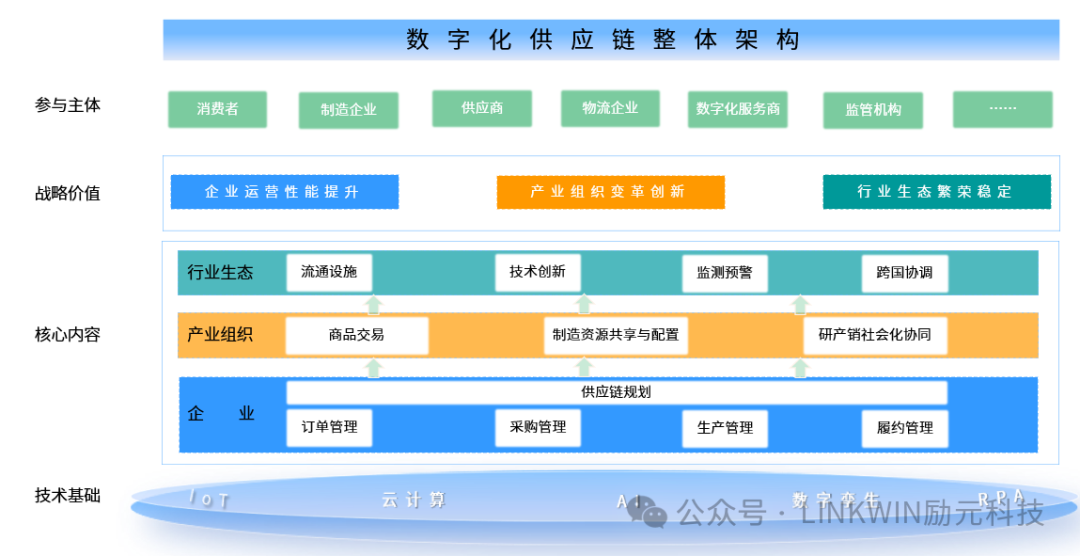
Amid the digital wave, the application of digital technologies has become key to upgrading internal management and overall operational architecture. Enterprises are continuously increasing investment in digital supply chain deployment to proactively address supply chain risks. By integrating technologies such as the Internet of Things, digital twin, AI, and cloud computing, enterprises consolidate end-to-end supply chain decision-making mechanisms, systems, and information transmission. This improves supply chain efficiency, transparency, agility, and resilience, drives industrial organizational reform, innovates business models, enables flexible resource allocation, enhances full-chain control over the supply chain, and forms a supply chain value community.
The Importance of End-to-End Supply Chain Information Visualization
As the external supply chain ecosystem integrates deeply with enterprise operation scenarios, businesses continue to drive technological innovation based on operational needs. From the perspective of the industry ecosystem, there is growing emphasis on end-to-end supply chain information visualization. For globally circulated products, there is an urgent need to record full lifecycle information from raw material processing to final sales. This places higher requirements on information carriers for products and information sharing standards among supply chain partners.
One Core of Digital Management: Product Digitization
_1774879053511.png)
Realizing Product Digital Management:Data Collection
Enterprises adopt automated data collection tools and technologies such as RFID tags, digital product identity IDs, and IoT devices to collect product data. This enhances information transparency, improves the accuracy of information transmission, effectively prevents counterfeiting and channel diversion, protects brand intellectual property rights, and safeguards consumer interests.
Realizing Product Digital Management:Data Analysis
The platform processes and analyzes collected data to help enterprises understand current product flows and predict future market demand, providing a scientific basis for procurement, inventory management, and marketing strategies. As global supply chains shift from agility to resilience, product digitization strengthens supply chain resilience, accurately identifies market trends and consumer profiles, and empowers enterprises to respond quickly to market changes.
Realizing Product Digital Management:
Through data visualization tools, the platform presents massive and complex product data in the form of charts and dashboards, helping managers quickly grasp detailed information across all dimensions of products. Product digital management enables accurate traceability, improves operational efficiency, and enhances user satisfaction. Combined with digital marketing, data-driven decisions boost product sales.
About Us
Founded in 2001, LINKWIN is a world-leading technology company specializing in digital services and smart IoT.
We provide innovative solutions and premium operational services in intelligent manufacturing, digital supply chains, digital marketing and industrial IoT platforms.
Today, LINKWIN operates across industrial, commercial, agricultural and government sectors, serving over 300 customers in more than 50 countries and regions.
We focus on economic value, helping clients improve operational efficiency and drive sustainable growth.
_1774854657505.webp)
Business & Innovation
Intelligent Manufacturing
Digital Supply Chain
Digital Marketing
Industrial IoT Platform
_1776162461880.jpg)



