Article Introduction
This article proceeds in three progressive sections: "Introduction to RFID Technology", "Basic Components of an RFID System", and "LINKWIN Case Study". It explores the application scenarios of RFID at a world-renowned enterprise — a pioneer and leader across diverse sectors including adhesives, beauty care, and detergents.
Introduction to RFID Technology
Radio Frequency Identification (RFID) achieves target identification through non-contact data communication between a reader and tags. RFID has a wide range of typical applications, including supply chain management, personnel management, inventory control, asset tracking, parking access control, production line automation, and material management.
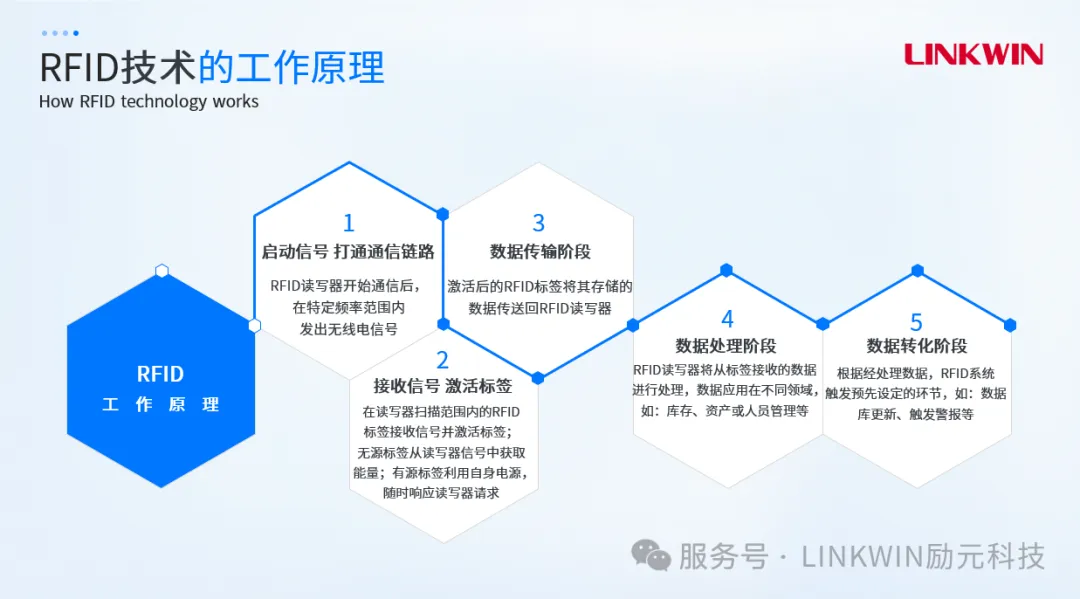
As a non-contact, rapid information exchange and storage technology via radio waves, RFID combines wireless communication with data access technology and connects to database systems to enable non-contact two-way communication for identification. It facilitates data exchange and connects highly complex systems. Electronic tags are read, written, and communicated via electromagnetic waves. Based on communication distance, systems are divided into near-field and far-field, with corresponding data exchange methods between readers/writers and electronic tags: load modulation and backscatter modulation.
Basic Components of an RFID System
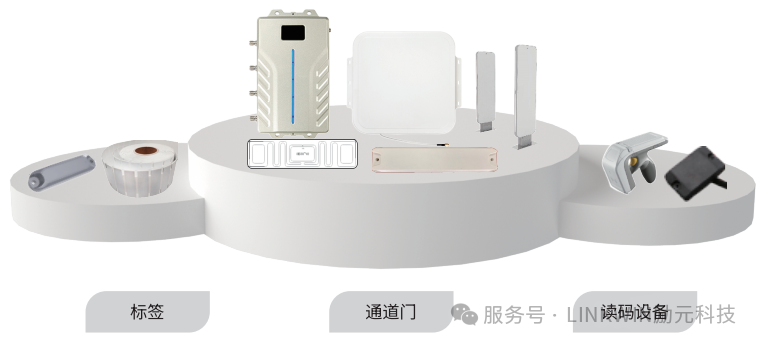
An RFID system mainly consists of RFID electronic tags, readers/writers, and application software. It is an automatic identification system that uses radio frequency identification technology for data collection and transmission.
Typically, when an RFID electronic tag enters the electromagnetic field emitted by a reader, the induced current obtained from the antenna is converted into chip power via a boost circuit. Energy from the induced current is converted into digital signals through the RF front-end circuit and sent to the logic control circuit for processing. Information to be replied is sent from the tag memory, returned to the RF front-end circuit via the logic control circuit, and finally transmitted back to the reader through the antenna.
🔺1. RFID Electronic Tag
An RFID electronic tag is a data carrier for item identification, equipped with an information storage mechanism that can receive modulated electromagnetic field signals from readers and return response signals. As the main hardware component of an RFID system alongside readers, its core parts are the tag antenna and tag chip.The full manufacturing process includes chip supply, antenna fabrication, primary encapsulation (forming inlays), secondary encapsulation (lamination), and post-printing processes.
🔺2. RFID Reader/Writer
RFID readers/writers perform reading and writing operations on electronic tag information.
Classified by operating frequency, they include low-frequency, high-frequency, and ultra-high-frequency products, used with corresponding RFID tags.
By integration of the read-write module and antenna: integrated readers (module and antenna packaged together) and split readers (module and antenna packaged separately, connected via coaxial cable).
The most common market classification is by portability: fixed readers and handheld readers. Fixed readers include gateway readers, card issuers, and cabinet readers; handheld readers include mobile terminals and wearable readers.
LINKWIN Case Study
Company Profile
The company holds an important position in the chemical industry, renowned for its extensive product portfolio and superior service quality. Its products cover adhesives, sealants, and more, widely used in automotive, construction, electronics, and other industries, providing customers with innovative solutions and high-quality product support.Committed to sustainable development through continuous technological innovation and market expansion, the company strives to become a global leader in the chemical industry, delivering more efficient and eco-friendly products and services to support customers’ long-term success.
Solution Overview
_1776071397645.png)
🔺Material and Process Management on Production Lines
Many niche industries require traceability data throughout production to track which processes each product undergoes. To meet this need, one RFID reader is installed at each process station, with an RFID tag applied to track pallets or carriers transporting components.
🔺Warehouse Management on Production Lines
This solution mainly manages inventories of industrial raw materials and finished products. RFID tags are added to turnover bins or directly attached to products, turning items into IoT-enabled assets with traceable and accessible information.
Turnover bins are reused or scrapped after multiple cycles, resulting in very low amortized cost per tag. With cost control and maximum efficiency, the system enables real-time automatic inventory counting, fast goods location, and optimal warehouse space utilization, greatly improving warehousing efficiency and management.
🔺Lean Management of Production Material Feeding
The RFID system collects real-time data across production stages, such as raw material consumption rates and production task completion status. Managers monitor progress in real time and adjust schedules promptly to avoid line stoppages from material shortages or delays.Unlike traditional manual material recording, which is prone to errors and omissions, RFID enables automatic collection and updating of material information, significantly reducing manual workload and error rates.
Project Application Value
LINKWIN provides customers with customized software for the entire supply chain. Through integrated RFID tags, hardware, and software platforms, traceability information can be queried at any stage as materials move through factories, distribution centers, and channels. This empowers customers to reduce production and distribution costs, improve inventory accuracy, and strengthen channel compliance management.
By improving data collection efficiency, enhancing inventory accuracy, optimizing turnover rates, lowering management costs, enabling precise location management, speeding up inbound and outbound operations, strengthening cargo tracking, supporting information sharing and collaboration, enabling real-time material tracking, boosting production efficiency, optimizing quality control, and supporting dynamic scheduling, RFID significantly elevates material inventory management, warehouse location control, and lean production feeding. It delivers substantial economic benefits and competitive advantages to the enterprise.
About Us
Founded in 2001, LINKWIN is a world-leading technology company specializing in digital services and intelligent IoT. We are committed to providing customers with innovative solutions and premium operational services in intelligent manufacturing, digital supply chain, digital marketing and industrial IoT platforms.Today, LINKWIN's business covers industry, commerce, agriculture, government affairs and other sectors, serving more than 300 customers in over 50 countries and regions worldwide. We always focus on economic value as the core, helping customers achieve operational efficiency and growth.
_1776071428502.webp)
Business & Innovation
Intelligent Manufacturing
LINKWIN deeply understands customers’ expectations for production line efficiency and empowers production digitalization.Through industrial vision, coding systems, production line OEE, lightweight MES, digital twin, digital dashboards and other solutions, we help enterprises produce high-quality products, reduce costs, improve efficiency and prioritize quality.
Innovation Highlights: Cloud Coding, Lightweight MES, LinkVision™ Visual Inspection
Digital Supply Chain
LINKWIN provides customized solutions for full-chain traceability marketing, product anti-counterfeiting and intelligent warehousing, realizing full-chain digital management of the supply chain with higher efficiency and transparency.
Innovation Highlights: MicroCode®, Full-Chain Traceability Solution
Digital Marketing
With "code + data" as the core link, LINKWIN delivers distinctive omnichannel digital marketing, helping brands accurately connect with consumers, build private domain traffic, achieve personalized operation, continuously drive sales conversion and expand brand influence.
Innovation Highlights: Mini-Program Smart Operation, Customized Omnichannel Marketing Solutions
Industrial IoT Platform
LINKWIN deploys hybrid cloud services to provide enterprises with dynamic and isolated IT resources. All data is secured by blockchain technology, supporting 30 billion annual new commodity data entries and 200,000 IoT nodes with reliable protection.
_1776157862679.jpg)